Insulin Storage and Travel: Fridge, Flights, Heat and the 28-Day Rule
What the EMA SmPCs actually specify for in-use insulin storage, what UK and EU airlines allow in cabin baggage, and what the 28-day rule does and doesn't mean.
By Daisy Lin
Medical Writer • Reviewed April 25, 2026
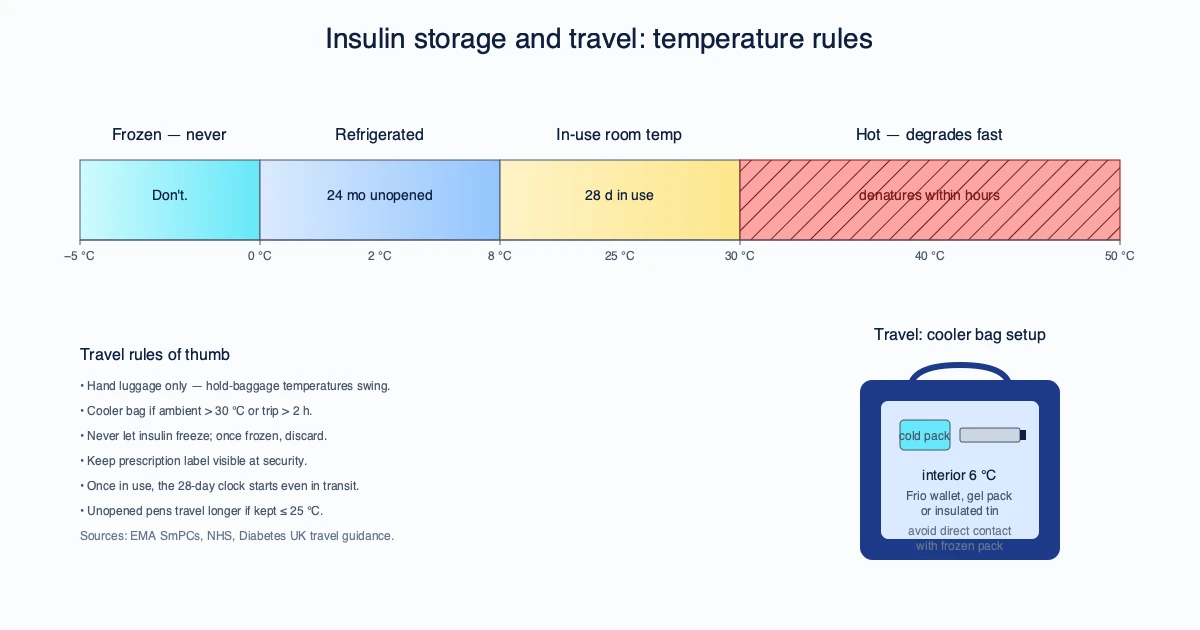
In-use insulin pens last 28 days at room temperature for most molecules — but Tresiba (degludec) lasts 56 days, Levemir 42, Insulatard 42, and the glargine products (Lantus, Toujeo) cap at 25 °C rather than the 30 °C ceiling for most other insulins. UK and EU airlines permit insulin in cabin baggage in any quantity needed; carry it in original packaging with a prescription copy. Never put insulin in the hold — cargo holds drop below freezing on long-haul flights, and frozen insulin must be discarded.
The "28-day rule" is one of the most-quoted and most-misunderstood numbers in insulin self-management. The per-pen storage limit varies by molecule, by formulation, and even by container — a vial of glargine and a SoloStar of glargine have slightly different in-use storage windows. This guide collects the actual numbers from the EMA Summaries of Product Characteristics for the insulins UK patients most commonly carry, plus what the Civil Aviation Authority and major airlines specify for cabin baggage on flights.
In-use storage: what the SmPCs actually say
These figures are the manufacturer's specified in-use storage at room temperature, below either 25 °C or 30 °C depending on the molecule. In-use means after the first dose has been drawn or injected from that container. Unopened, refrigerated stock is governed by the printed expiry date.
| Insulin (brand) | Molecule | In-use limit | Maximum temp |
|---|---|---|---|
| NovoRapid FlexPen, Penfill, vial | Insulin aspart | 28 days | 30 °C |
| Humalog KwikPen, vial | Insulin lispro | 28 days | 30 °C |
| Apidra SoloStar | Insulin glulisine | 28 days | 25 °C |
| Lantus SoloStar | Insulin glargine 100 U/mL | 28 days | 25 °C |
| Toujeo SoloStar / DoubleStar | Insulin glargine 300 U/mL | 28 days | 25 °C |
| Tresiba FlexTouch | Insulin degludec | 56 days | 30 °C |
| Levemir FlexPen | Insulin detemir | 42 days | 30 °C |
| Insulatard FlexPen / Penfill | Isophane (NPH) | 42 days | 30 °C |
| Fiasp FlexTouch | Insulin aspart (faster-acting) | 28 days | 30 °C |
Sources: respective EMA Summaries of Product Characteristics. Where any pen has a different in-use limit from its corresponding vial or cartridge, we have used the pen number; vials are typically a few days shorter.
The two most useful numbers in this table are Tresiba's 56 days, which is meaningfully longer than the 28-day default and matters for low-dose users, and the 25 °C ceiling on glargine products (Lantus, Toujeo, Apidra), which is lower than the 30 °C ceiling for most other insulins and matters in summer.
What the 28-day rule actually means
It does not mean the insulin spoils on day 29. The 28 days (or 42, or 56) is the period for which the manufacturer guarantees full potency under typical in-use conditions, which include repeated removal from a temperature-controlled environment, exposure to ambient temperature, mechanical handling and the small ingress of air through the rubber stopper at each injection.
A pen that has been kept consistently below room temperature, opened, and used in a relatively cool environment will remain effective for longer than the manufacturer's specified window, but that is not a number the manufacturer commits to. The Heinemann et al. 2017 review of insulin stability outside refrigeration found that most analogue insulins retained more than 95% of their stated potency at 30 °C for periods substantially beyond their official in-use limits, with the major exception being formulations stored at the upper end of their permitted temperature range.
The practical implications:
- Do not rely on out-of-window insulin in routine use. The labelling exists for a reason, including manufacturing-batch variability the manufacturer cannot predict for any individual pen.
- Do not panic about 30 minutes at 31 °C in a hot taxi. Brief excursions above the labelled ceiling do not measurably degrade potency. The labelling is for sustained exposure.
- Date the pen on first use. Write the date with a marker on the pen body. This is the single most useful habit for managing the in-use window without anxiety.
Travel — UK and EU flights
The UK Civil Aviation Authority confirms that insulin and associated injection equipment can be carried in cabin baggage in any quantity necessary for the duration of the flight, plus a reserve. This is treated as a medical exception to the standard 100 mL liquid restriction. You should:
- Carry insulin in original boxed packaging where possible — the pharmacy label is your evidence of medical necessity
- Carry a copy of your prescription or a doctor's letter for international travel (a single sentence stating the medical condition and the medication is sufficient; most UK GPs will issue this on request)
- Keep insulin in the cabin, not the hold. Cargo holds on long-haul flights can drop below freezing, and frozen insulin must be discarded — every SmPC is unambiguous on this.
The same rules apply across all UK and EU departures. Major non-EU jurisdictions (US TSA, Australia, Canada) have very similar carve-outs for medical liquids; check the destination airport's specific guidance before flying.
What to put in the cabin bag
For a one-week trip:
- All insulin pens or vials in original packaging
- Pen needles in their original sealed pack — the manufacturer label and CE mark are your evidence
- Glucose test strips and meter
- Hypoglycaemia treatment (glucose tablets or equivalent)
- A small sharps disposal container; most airlines do not object to a sealed sharps bin
- Prescription copy or letter
Heat protection
For travel in summer, or to climates above the 25–30 °C ceiling for your molecule, an insulated pouch designed for insulin is worth the £15–25 it costs. Frio wallets (evaporative-cooling, no refrigeration required) and Medactiv iCool (gel-pack-based) are the two products patient communities have used longest. Both work; the Frio is simpler and reactivates with tap water, the iCool keeps a tighter temperature for longer with active gel-pack use. The Frio sleeve has a faint vinegar smell on first activation that fades within an hour.
For the travel kit itself, the InjectKit 30G × 5 mm pen needle 100-pack is small enough to redistribute into a 10-pack travel sleeve without taking a whole compartment, and the 1 L home sharps container covers the return-leg disposal when no pharmacy take-back is on the route.
Storage in your home
Refrigerator at 2–8 °C for unopened stock — the same temperature range every household refrigerator runs at by default. Do not store insulin in the freezer compartment. Do not store it in the door (where temperature swings are largest); the main shelf is more stable.
Once a pen is in use, it does not go back in the fridge. Room-temperature storage below the molecule's labelled ceiling is what the manufacturer specifies, and switching back-and-forth between fridge and room temperature is a known cause of cartridge contents looking visibly different (small bubbles, condensation on the rubber stopper). It is harmless cosmetically but unnecessary.
What to do if a pen has been frozen, mishandled or left out
Frozen insulin must be discarded. There is no ambiguity in any of the EMA SmPCs on this point — every analogue insulin labelled in the EU specifies discard after freezing. The protein structure is irreversibly altered.
Sustained exposure above the labelled ceiling for more than a few hours, or visible discolouration, or any visible crystallisation in the cartridge, are all reasons to discard. The pen may still inject; that is not the question. The question is whether you can rely on the dose being what the dial says, and after a meaningful storage excursion, you cannot.
If you are unsure and you are about to take a clinically significant dose, the conservative answer is to use a fresh pen. Insulin is the cheap part of insulin therapy. The expensive part is a misjudged dose.
FAQ
Can I refrigerate an in-use insulin pen? No. Once a pen is in use, it stays at room temperature below its labelled ceiling. Repeated fridge-to-room cycling causes condensation and air bubbles in the cartridge.
How long does Tresiba last in use? 56 days at room temperature below 30 °C — the longest in-use limit of any common UK insulin.
Can I take insulin in hand luggage on flights? Yes. UK CAA and EU regulations permit insulin and associated supplies in cabin baggage in any quantity necessary, exempt from the 100 mL liquid rule. Carry a prescription copy.
What if my insulin freezes accidentally? Discard it. Frozen insulin is irreversibly altered and every EMA SmPC specifies discard after freezing.
Do I need a Frio wallet for a weekend trip? For trips under 24 hours in cool conditions, an insulated wallet is usually sufficient. For trips over 24 hours, particularly in summer or warm climates, a Frio or iCool case is worth the cost.
For travel-ready supplies — compact 10-pack pen needles, individually wrapped alcohol pads and small home sharps bins — pick up the 30G × 5 mm pen needle 100-pack or browse the full 30G travel range.
Sources
- European Medicines Agency, Lantus EPAR — ema.europa.eu
- European Medicines Agency, Tresiba EPAR — ema.europa.eu
- European Medicines Agency, NovoRapid EPAR — ema.europa.eu
- European Medicines Agency, Toujeo EPAR — ema.europa.eu
- NHS, Travelling with insulin — nhs.uk
- UK Civil Aviation Authority, Medicines and medical equipment — caa.co.uk
- Heinemann L, Braun M, Kaltheuner M, Liebl A. Stability of insulins in unrefrigerated conditions. Diabetes Technol Ther. 2017;19(11):625–633 — doi.org
This article is for general information only and is not medical advice. Always consult your prescriber or pharmacist for guidance specific to your situation.
Frequently asked questions
Can I refrigerate an in-use insulin pen? +
No. Once a pen is in use, it stays at room temperature below its labelled ceiling. Repeated fridge-to-room cycling causes condensation and air bubbles in the cartridge.
How long does Tresiba last in use? +
56 days at room temperature below 30 °C — the longest in-use limit of any common UK insulin.
Can I take insulin in hand luggage on flights? +
Yes. UK CAA and EU regulations permit insulin and associated supplies in cabin baggage in any quantity necessary, exempt from the 100 mL liquid rule. Carry a prescription copy.
What if my insulin freezes accidentally? +
Discard it. Frozen insulin is irreversibly altered and every EMA SmPC specifies discard after freezing.
Do I need a Frio wallet for a weekend trip? +
For trips under 24 hours in cool conditions, an insulated wallet is usually sufficient. For trips over 24 hours, particularly in summer or warm climates, a Frio or iCool case is worth the cost.
For travel-ready supplies — compact 10-pack pen needles, individually wrapped alcohol pads and small home sharps bins — pick up the 30G × 5 mm pen needle 100-pack or browse the full 30G travel range.
Related reading
Lipohypertrophy: How to Spot Insulin Injection Lumps, Treat Them, and Prevent More
Two-thirds of insulin-treated adults have lipohypertrophy in at least one site. Three habits drive most cases. Here's how to spot, treat and prevent lipo lumps.
Diabetes in Cats: Which Insulin Syringe and How to Dose Correctly
Diabetes in cats — choosing the right U-40 insulin syringe, drawing the dose cleanly, sterile technique and safe disposal. A complete UK practical guide.
U-100 vs U-40 Insulin Syringes: Why Pets Need a Different Scale
U-40 vs U-100 insulin syringes explained — why veterinary insulin uses a different scale, why mixing them up is dangerous, and how to pick the right one.
Get your supplies
CE-marked syringes and alcohol prep pads. Shipped from Spain across the EU and UK.